Glucoamylase Premium for Glucose Syrup Production
Process guide for Glucoamylase Premium in glucose syrup: saccharification conditions, dosage, QC, pilot trials, and B2B sourcing checks.
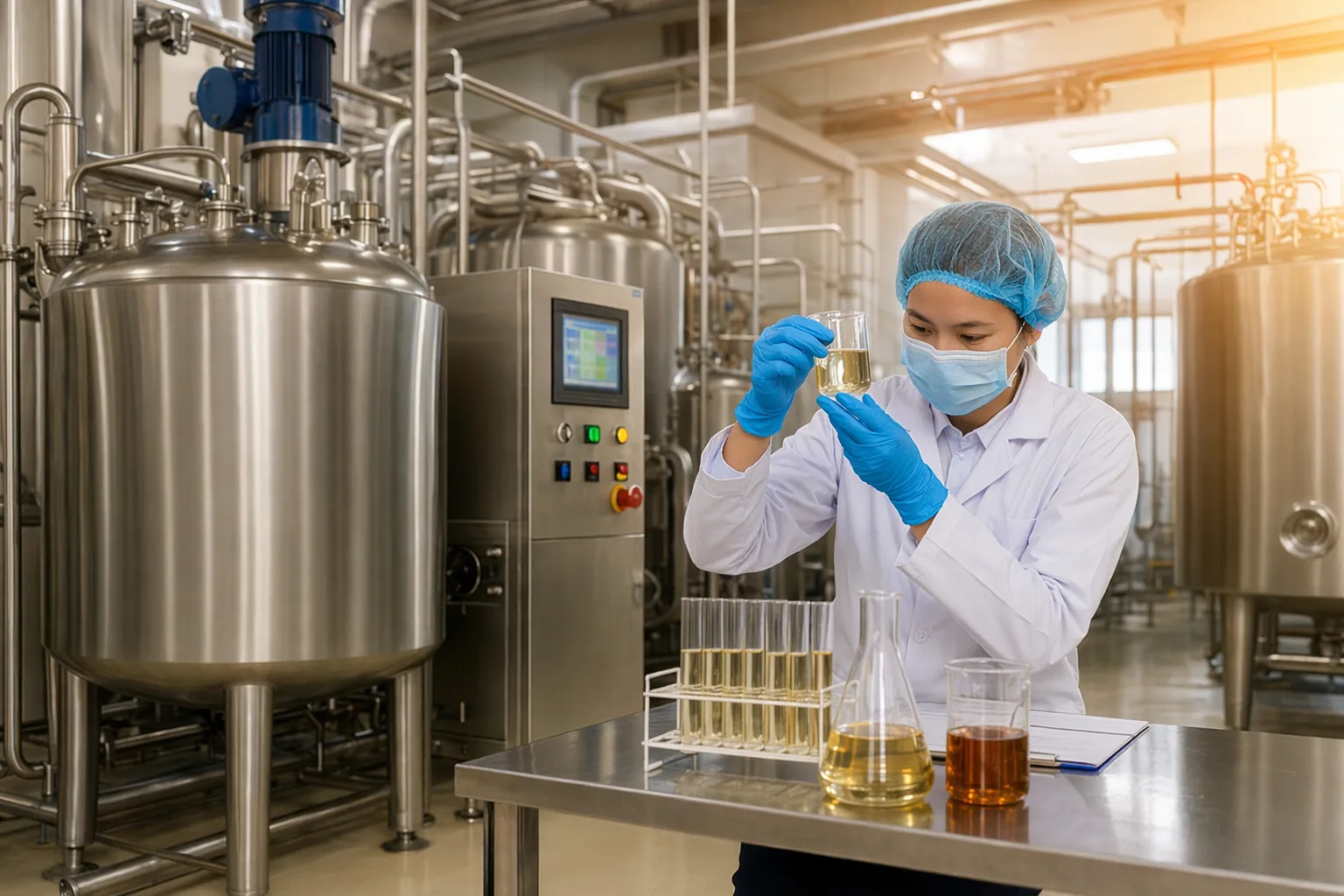
A practical guide for starch processors evaluating a premium saccharification enzyme for high-DE glucose syrup, stable conversion, and cost-in-use control.
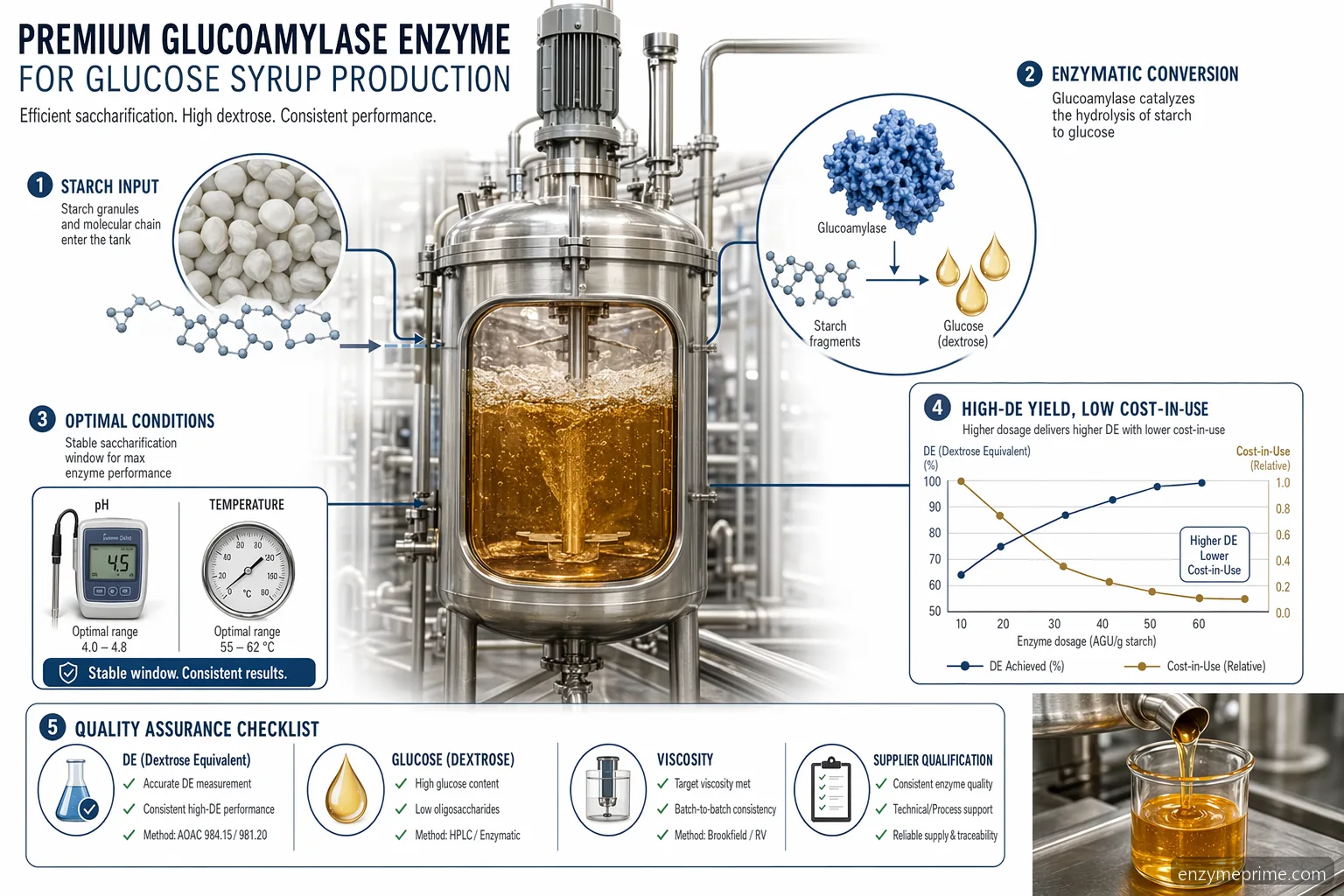
What Is Glucoamylase Enzyme in Glucose Syrup Production?
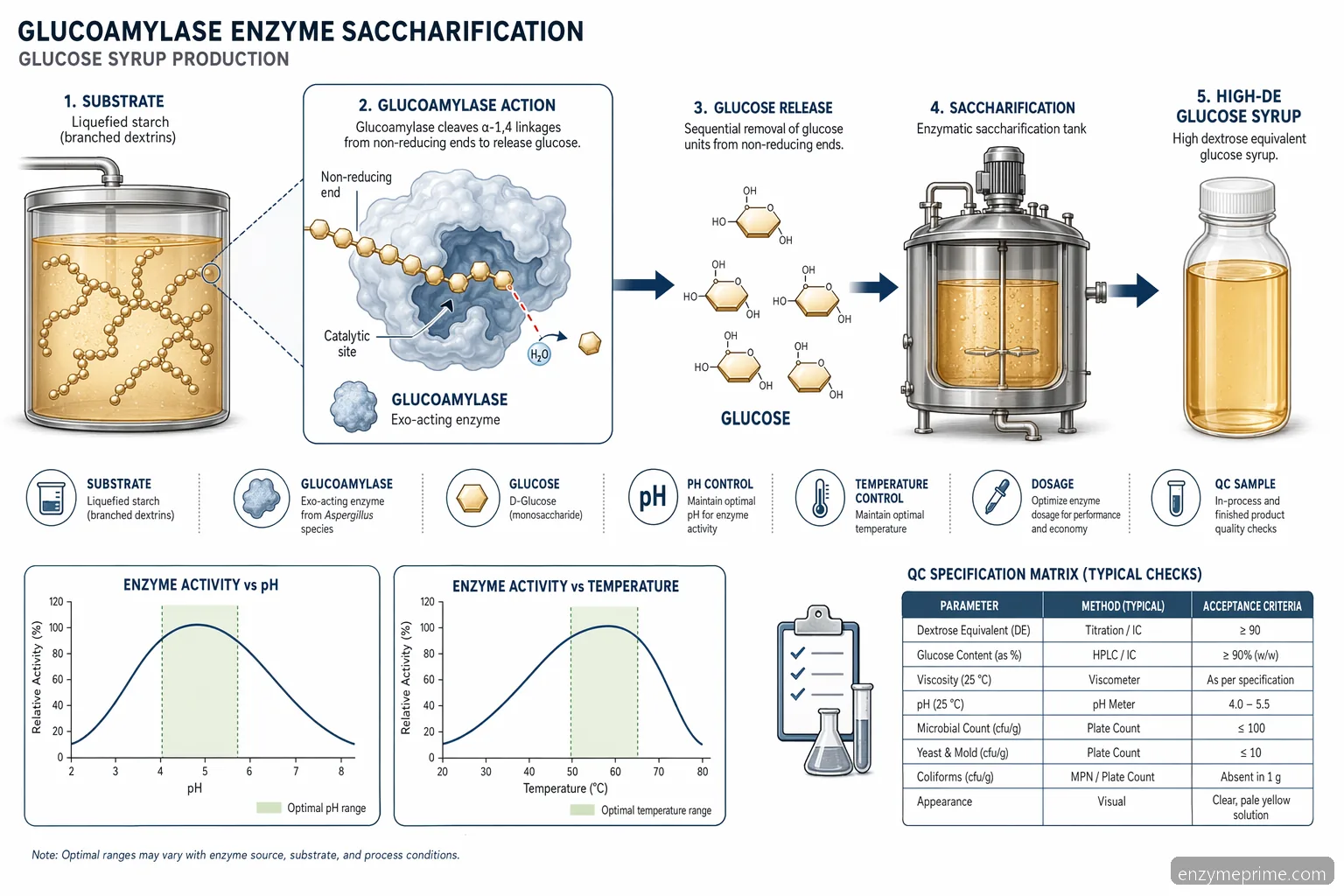
Glucoamylase enzyme, also called amyloglucosidase or AMG, is a saccharification enzyme used after starch liquefaction. In glucose syrup production, liquefied starch contains dextrins with alpha-1,4 and limited alpha-1,6 linkages. The glucoamylase enzyme function is to release glucose units from the non-reducing ends of these chains, increasing dextrose equivalent and fermentable sugar yield. For industrial buyers, the value is not simply activity per gram; it is predictable conversion at the plant’s dry solids, pH, temperature, and residence time. Glucoamylase Premium is positioned for processors making glucose syrup and downstream sweetener feedstocks such as high fructose corn syrup, where consistent saccharification supports filtration, evaporation, isomerization, and finished syrup specifications. It is not a medical or dietary supplement ingredient guide. Procurement teams should evaluate the enzyme as a processing aid with defined technical documentation, application trials, and batch-to-batch quality controls.
Primary use: starch to glucose enzyme for saccharification • Process stage: after alpha-amylase liquefaction • Common targets: high DE glucose syrup and HFCS feedstock • Buyer focus: conversion efficiency, consistency, and cost-in-use
Recommended Saccharification Process Conditions
A typical glucose syrup process begins with starch slurry preparation, gelatinization, and liquefaction using thermostable alpha-amylase. After liquefaction, the mash is adjusted for glucoamylase saccharification. Common operating conditions for glucoamylase are pH 4.0-4.5 and 58-62°C, with residence time often ranging from 24 to 72 hours depending on DE target, substrate, enzyme activity, and dry solids. Some plants may run slightly outside these bands after validation, but uncontrolled pH or temperature can reduce conversion rate or enzyme stability. Dry solids commonly fall in the high-solids syrup range, and mixing must be sufficient to prevent localized pH variation. Calcium, residual liquefaction enzyme, protein load, and retrograded starch can also influence results. Always confirm glucoamylase enzyme temperature and pH tolerance against the product TDS and validate with your actual liquefied starch, not only a laboratory reference substrate.
Typical pH: 4.0-4.5 • Typical temperature: 58-62°C • Typical residence time: 24-72 hours • Validate against plant substrate and DE target
Dosage Strategy and Cost-in-Use Optimization
Industrial dosage should be expressed against starch dry substance or liquefied mash solids, not as a fixed amount per tank without context. A practical starting band for trial work is often 0.2-0.8 kg enzyme preparation per metric ton of dry starch, but the correct dose depends on declared activity, substrate quality, target DE, saccharification time, and syrup specifications. A lower unit price may not deliver the lowest cost-in-use if it requires higher dosage, longer holding time, or causes variable glucose yield. During pilot validation, compare Glucoamylase Premium across at least three dosage levels and measure DE development over time. Include steam, tank occupancy, filtration performance, evaporation load, and rework risk in the economic model. The best enzyme glucoamylase program is the one that reaches specification reliably at the lowest total processing cost, not merely the lowest purchase price per kilogram.
Trial dosage across low, medium, and high inclusion rates • Track DE curve rather than only final DE • Include residence time and utility costs • Compare cost per ton of finished syrup
QC Checks for Reliable Glucose Syrup Output
Quality control should confirm both incoming enzyme quality and process performance. For each lot of Glucoamylase Premium, request a certificate of analysis showing relevant activity, appearance, and microbiological or contaminant checks appropriate to the product grade. In process, monitor pH, temperature, dry solids, DE, glucose profile, iodine reaction, viscosity, and filtration behavior. HPLC sugar profiling is useful when the syrup will feed isomerization or fermentation, because residual maltose and higher saccharides can affect downstream yield. Sampling should be consistent by tank position and time, especially in high-solids systems where mixing gradients may occur. If conversion stalls, investigate liquefaction DE, pH drift, temperature deviation, enzyme age, microbial contamination, and substrate variability before increasing dose. Robust QC prevents overuse of enzyme and helps procurement teams make supplier comparisons based on measured plant outcomes.
Incoming lot review: COA against purchase specification • Process checks: pH, temperature, DE, dry solids, viscosity • Sugar profile: glucose, maltose, DP3+ by HPLC where needed • Troubleshooting: verify liquefaction and pH before redosing
Supplier Qualification for B2B Enzyme Buyers
Before approving a glucoamylase supplier, request the technical data sheet, safety data sheet, certificate of analysis format, storage guidance, shelf-life statement, and application support process. The TDS should describe activity basis, recommended pH and temperature range, dosage guidance, packaging, and handling requirements. The SDS should support safe transport, warehousing, and plant handling procedures. Ask whether pilot samples are available and whether the supplier can help design a saccharification trial with control and treated batches. Avoid relying on broad marketing claims without plant data. A qualified supplier should support batch traceability, consistent documentation, responsive technical service, and transparent change notification for formulation or activity adjustments. For multi-site processors, also evaluate logistics reliability, lead time, packaging compatibility, and commercial scalability. Supplier qualification is a risk-control step as much as a purchasing step.
Request COA, TDS, SDS, shelf-life, and storage documents • Run pilot validation before production approval • Confirm traceability and change notification practices • Evaluate logistics, lead time, and packaging fit
Glucoamylase vs Amylase Enzyme in Starch Conversion
The comparison of glucoamylase vs amylase enzyme is important because both are used in starch processing but perform different functions. Alpha-amylase is typically used first during liquefaction, where it rapidly breaks gelatinized starch into shorter dextrins and reduces viscosity. Glucoamylase is then used during saccharification, where it releases glucose from dextrin chain ends to increase DE and glucose concentration. In most glucose syrup plants, these enzymes are complementary rather than interchangeable. Poor liquefaction can limit glucoamylase performance because the substrate may contain resistant structures, high viscosity, or inconsistent dextrin distribution. Conversely, excessive focus on liquefaction without adequate saccharification can leave too much maltose or higher saccharides. The best process design aligns both enzyme systems with starch source, solids level, residence time, and final syrup specification.
Alpha-amylase: liquefaction and viscosity reduction • Glucoamylase: saccharification and glucose release • Both stages affect final DE and syrup consistency • Optimization should consider the full enzyme sequence
Technical Buying Checklist
Buyer Questions
Glucoamylase enzyme is used during saccharification to convert liquefied starch dextrins into glucose. After alpha-amylase reduces viscosity and creates shorter chains, glucoamylase releases glucose units and helps raise dextrose equivalent. In glucose syrup production, it supports high glucose content, consistent syrup specification, and suitable feedstock for downstream processes such as isomerization.
Many glucose syrup plants operate glucoamylase saccharification around pH 4.0-4.5 and 58-62°C. These are practical starting conditions, not a substitute for validation. The best operating point depends on enzyme activity, starch source, liquefaction quality, dry solids, residence time, and final DE target. Always compare trial results with the supplier’s TDS.
Begin with a pilot trial using several dosage levels, commonly around 0.2-0.8 kg per metric ton of dry starch for evaluation, depending on product activity. Track DE development, glucose profile, viscosity, filtration, and final syrup quality. The selected dose should meet specification at the lowest cost-in-use, including enzyme, tank time, utilities, yield, and rework risk.
No. Alpha-amylase and glucoamylase are both starch-processing enzymes, but they perform different roles. Alpha-amylase is typically used for liquefaction to reduce viscosity and produce dextrins. Glucoamylase is used later for saccharification to release glucose from those dextrins. In glucose syrup production, they are usually complementary steps in a controlled enzyme sequence.
Request the certificate of analysis, technical data sheet, safety data sheet, shelf-life and storage guidance, packaging details, and a clear activity specification. For supplier qualification, also ask about traceability, change notification, pilot sample availability, technical support, lead time, and commercial scalability. Final approval should be based on plant validation, not documentation alone.
Glucoamylase (Premium Grade) for Research & Industry
Need Glucoamylase (Premium Grade) for your lab or production process?
ISO 9001 certified · Food-grade & research-grade · Ships to 80+ countries
Frequently Asked Questions
What is glucoamylase enzyme used for in glucose syrup plants?
Glucoamylase enzyme is used during saccharification to convert liquefied starch dextrins into glucose. After alpha-amylase reduces viscosity and creates shorter chains, glucoamylase releases glucose units and helps raise dextrose equivalent. In glucose syrup production, it supports high glucose content, consistent syrup specification, and suitable feedstock for downstream processes such as isomerization.
What pH and temperature are typical for glucoamylase saccharification?
Many glucose syrup plants operate glucoamylase saccharification around pH 4.0-4.5 and 58-62°C. These are practical starting conditions, not a substitute for validation. The best operating point depends on enzyme activity, starch source, liquefaction quality, dry solids, residence time, and final DE target. Always compare trial results with the supplier’s TDS.
How should an industrial buyer set the correct glucoamylase dosage?
Begin with a pilot trial using several dosage levels, commonly around 0.2-0.8 kg per metric ton of dry starch for evaluation, depending on product activity. Track DE development, glucose profile, viscosity, filtration, and final syrup quality. The selected dose should meet specification at the lowest cost-in-use, including enzyme, tank time, utilities, yield, and rework risk.
Is glucoamylase the same as amylase?
No. Alpha-amylase and glucoamylase are both starch-processing enzymes, but they perform different roles. Alpha-amylase is typically used for liquefaction to reduce viscosity and produce dextrins. Glucoamylase is used later for saccharification to release glucose from those dextrins. In glucose syrup production, they are usually complementary steps in a controlled enzyme sequence.
What documents should be requested before approving a supplier?
Request the certificate of analysis, technical data sheet, safety data sheet, shelf-life and storage guidance, packaging details, and a clear activity specification. For supplier qualification, also ask about traceability, change notification, pilot sample availability, technical support, lead time, and commercial scalability. Final approval should be based on plant validation, not documentation alone.
Related: Buy Glucoamylase for Reliable Starch Conversion
Turn This Guide Into a Supplier Brief Request Glucoamylase Premium TDS, COA sample, SDS, and pilot-trial support for your glucose syrup line. See our application page for Buy Glucoamylase for Reliable Starch Conversion at /applications/buy-glucoamylase-price/ for specs, MOQ, and a free 50 g sample.
Contact Us to Contribute